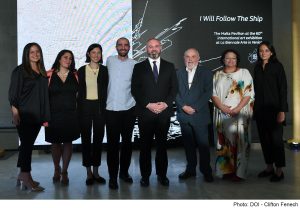
Minister for the National Heritage, the Arts and Local Government Owen Bonnici launched the Malta Pavilion at the Venice Art Biennale, in Italy. The pavilion was commissioned by Arts Council Malta, where Malta will be represented by solo artist Matthew Attard and his innovative project, I Will Follow the Ship.
Attard’s exhibition converges historical ship graffiti found across the islands of Malta with digital technology as a contemporary drawing practice. The co-curators of I Will Follow the Ship are Elyse Tonna and Sara Dolfi Agostini. Maria Galea and Galleria Michela Rizzo are overseeing the project’s management, Vincenzo Casali is the consulting architect, and Joey Borg is handling the project’s programming and software development.
In a speech he gave in Venice on the occasion, Minister Bonnici explained how La Biennale di Venezia is one of the most prestigious international institutions in the cultural sector for the presentation and promotion of contemporary art. He said that after a long absence of 17 years, the 60th edition of the Venice Biennale shall mark Arts Council Malta’s fourth participation with its own National Pavilion since 2017, when Malta re-entered the Biennale with “Homo Melitensis: An incomplete history in 19 chapters” exhibition. Arts Council Malta also commissioned Malta’s participation in the 2019 and 2022 editions, with “Maleth / Haven / Port—Heterotopias of Evocation” and “Diplomazija Astuta” respectively.
Minister Bonnici thanked Arts Council Malta, under the leadership of Executive Chair Albert Marshall, and stated that the Council is doing crucial work in the promotion of local artists, both locally and abroad.
Arts Council Malta’s Executive Chair Albert Marshall stated that Matthew Attard is the perfect example of a young artist from a small country who has managed to overcome these geographic limits. He said that his perseverance and determination to succeed, together with his passion for the arts, and his extraordinary talent, have led him to Venice.
Mr Marshall explained that the Biennale’s theme, ‘Foreigners Everywhere’, has resonances with Malta’s Pavilion, where our own departure point and “nucleo storico” (the name given to a special selection of the International Exhibition of Art) are humble and anonymous ship graffiti, which, despite being found across Malta and being part of our rich cultural heritage, are also found in many countries and locations within the Mediterranean Basin. Mr Marshall augured that the Maltese team at the Biennale would have a resounding success. He also thanked Mary Ann Cauchi, Director of Funds and Strategy at Arts Council Malta, Dr Romina Delia, the Internationalisation Executive project leading the Malta Pavilion at the Venice Biennale on behalf of at Arts Council Malta, as well as the other members of the International team at ACM, Dr Frank Psaila (communications) and Celine Portelli (support coordinator).
Artist Matthew Attard during the launch stated that it is a great honour and responsibility to be entrusted with the first solo Malta Pavilion at La Biennale di Venezia. His long-held interest in the act of painting has allowed him to explore the intersection of historical, etched ship graffiti, contemporary painting, and digital technology. By examining historical imagination through eye movement data acquired via apparatus which follows and uses the human eye as a painting tool, Attard prompts reflections about authorship and the contemporary dependence on digital technology, while at the same time reflecting on our limitless faith in the latter.
Co-curator, Elyse Tonna – the youngest and first Maltese female curator to form part of the youngest team to present a Maltese pavilion at the Venice Biennale – described how in I WILL FOLLOW THE SHIP, the imagery of the ship emerges as a timeless symbol of hope and possibility, transcending the constraints of time and uncertainty. Whether carved into weathered chapel walls or digitally rendered, this symbol resonates in today’s age of technological progress.
Co-curator, Sara Dolfi Agostini explained how Matthew Attard’s work challenges notions of authorship, agency and co-habitation, bringing into the Biennale the powerful lingua franca of the maritime community. It is a lingua franca made of residual images which belong to Malta, to Venice and to everybody – a means of communication across borders and cultures for the uncharted waters of the information society and its wider ecology.
Established in 1895, La Biennale di Venezia is a platform for exhibiting the works of international artists and is recognised as one of the most prestigious international cultural institutions for the preservation and the promotion of contemporary art.
The Malta Pavilion at La Biennale di Venezia will be open for the public between 20th April and 24th November 2024.